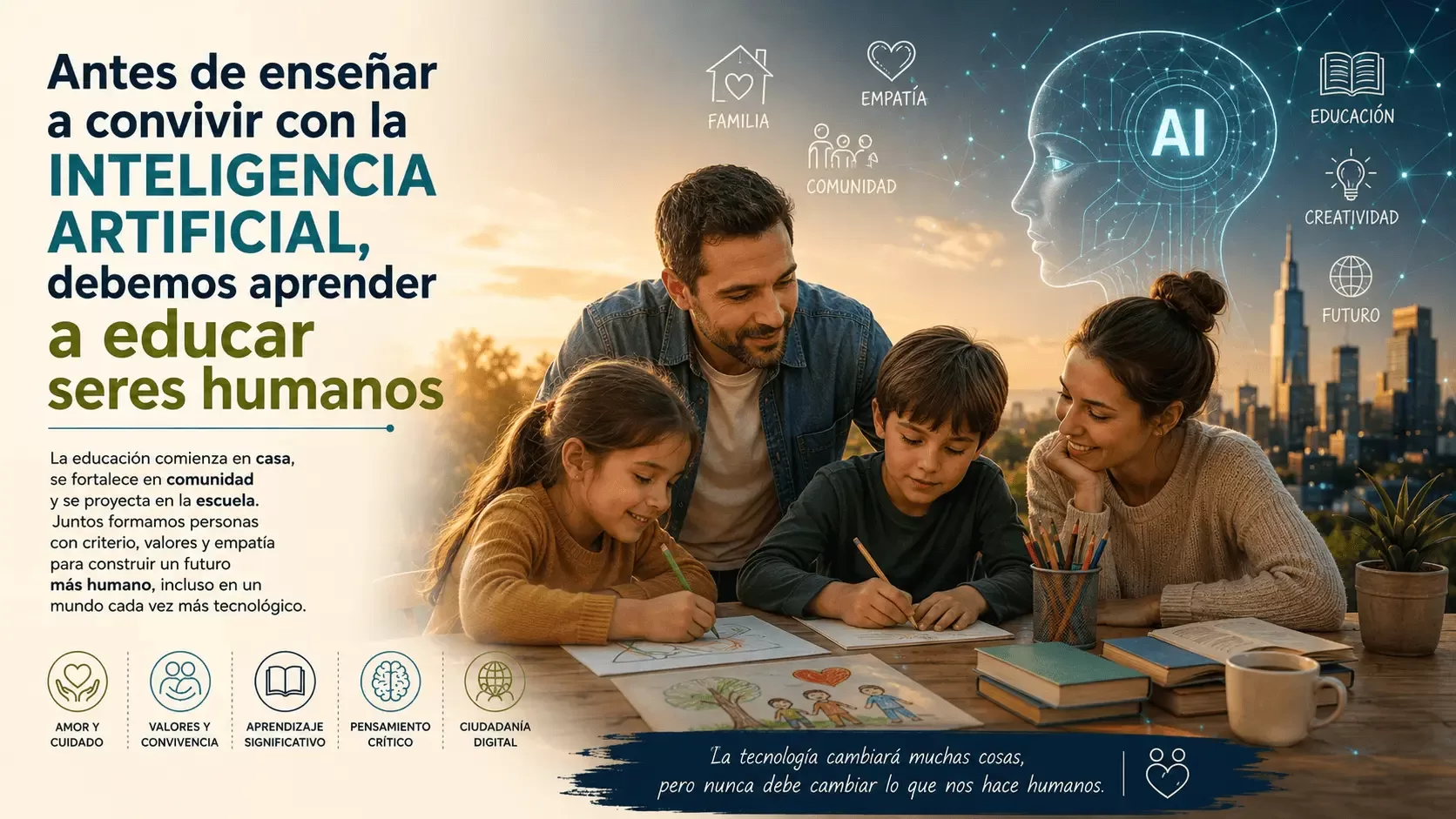
Early childhood, parenting education, and the partnership between family and school in the face of one of the great educational challenges of the 21st century
There is a question that has occupied much of my thinking about education and technology for some time:
Are we preparing our children only to use the tools of the future, or are we educating human beings who will be capable of living meaningful lives in that future?
They are not exactly the same thing.
For much of my professional life, I have been involved with technology and software development. I have witnessed an extraordinary transformation: we went from computers with extremely limited capabilities to artificial intelligence systems that can have conversations, write code, analyze large amounts of information, create images, and perform intellectual tasks that, until only a few years ago, we considered exclusively human.
And we are probably only at the beginning.
Paradoxically, the more powerful technology becomes, the more convinced I am that one of our greatest challenges will not be technological.
It will be human and educational.
Education Begins Long Before a Child Enters School
For years, I have held a personal conviction: what happens at home and during the first years of life has an enormous influence on the person who will later become an adolescent and an adult.
When I began studying education, I discovered that this conviction has significant support in research on child development, although it also requires some important qualifications.
The World Health Organization considers the early years a critical period of development and points out that children need, among other things, good health, adequate nutrition, security and safety, opportunities for early learning, and responsive caregiving. The WHO also emphasizes that families are the primary providers of this nurturing environment during the first years of life and that many families need support to provide it effectively [1].
UNICEF and the World Health Organization have developed the Care for Child Development program specifically to help parents and caregivers recognize children's signals, respond appropriately, and use play and communication to support motor, cognitive, language, social, and emotional development [2].
The Center on the Developing Child at Harvard University also explains the importance of responsive, back-and-forth interactions between young children and caring adults—what it calls serve and return—in building brain architecture and supporting later social and cognitive development [3].
This tells us something deeply important:
Before a child ever has a teacher, that child is already learning.
A child learns when someone responds to a cry.
When they have to wait.
When they play.
When they listen.
When they discover limits.
When they make mistakes.
When they observe how adults deal with conflict.
When they learn that frustration can be tolerated.
When they begin to understand that other people have needs too.
Education, understood in its broadest sense, begins long before the first day of school.
But We Must Avoid an Overly Simple Conclusion
It would be tempting to say that a good education during the first six years of life will necessarily produce adolescents without addictions, adults with high self-esteem, or happy people.
Science does not allow us to make such a deterministic claim.
Human behavior depends on an extraordinarily complex combination of biological, family, psychological, social, economic, cultural, and environmental factors.
However, there are some very interesting associations.
A meta-analytic review that included 150 studies, 745 effect sizes, and more than 215,000 participants found that self-regulation during childhood was associated with multiple outcomes later in life. Preschool self-regulation was positively associated with social competence, school engagement, and academic performance, while self-regulation during the early school years was later related to several behavioral and health outcomes. The researchers even found associations with later smoking, drug use, and substance abuse [4].
This does not mean that teaching self-regulation to a child guarantees that they will never develop an addiction.
It means something more careful and scientifically defensible:
During childhood, we can help children develop abilities that may later serve as protective factors.
For me, that distinction is fundamental.
And Then a Screen Appears
There is another dimension that previous generations of parents never had to face with the same intensity we do today.
Digital life.
Smartphones, social media, video games, streaming platforms, and recommendation systems are now part of the environment in which our children develop their identities, relationships, and habits.
But we should not fall into the opposite extreme and assume that all technology is harmful.
The American Psychological Association specifically warns that social media use is not inherently beneficial or harmful to all young people. Its effects depend on the child or adolescent, their characteristics and vulnerabilities, their context, and the type of content and features they interact with [5].
At the same time, there are enough reasons for us to act carefully.
The U.S. Surgeon General's advisory on social media and youth mental health reports that up to 95% of young people between the ages of 13 and 17 say they use a social media platform, and approximately one-third report using social media “almost constantly.” The same advisory discusses research in which more than three hours per day of social media use was associated with approximately twice the risk of certain mental health problems, including symptoms of depression and anxiety [6].
We need to interpret this information correctly: a statistical association does not, by itself, prove that social media directly causes these problems.
But neither should we ignore the warning signs.
The APA recommends that, particularly during early adolescence, adults provide monitoring, discussion, and guidance around digital content, with autonomy increasing gradually as young people develop digital literacy and skills [5].
For that reason, I do not believe the solution is to declare war on technology.
I believe we need to teach our children how to use it.
Not to Keep Them Away from Technology, but to Prepare Them for It
As a software engineer, it would be contradictory for me to suggest that the educational solution is simply to turn off every screen.
Technology can educate, connect people, democratize access to knowledge, stimulate creativity, and create extraordinary opportunities.
Artificial intelligence will multiply many of those possibilities.
So, for me, the important question is not:
How do we keep our children away from technology?
It is:
How do we educate human beings who can use technology without allowing their well-being to become completely dependent on it?
I believe part of that preparation begins long before a child opens their first social media account.
It begins by gradually developing abilities such as self-regulation, autonomy, empathy, tolerance for frustration, critical thinking, and the capacity to build healthy relationships with other people.
And many of those first experiences happen at home.
But Who Teaches Us How to Be Parents?
This brings me to one of the ideas that will probably generate the most discussion.
To drive a car, we need preparation.
To practice many professions, we study for years.
To become a teacher, we need pedagogical preparation.
Yet, to take on one of the responsibilities with the greatest consequences in human life—participating directly in the development of another human being—we generally learn while we are already doing it.
I think we should ask ourselves whether we can do better.
And once again, I found interesting evidence.
In its report Parenting Matters: Supporting Parents of Children Ages 0–8, the National Academies of Sciences, Engineering, and Medicine reviewed decades of research and concluded that parent-child relationships and the family environment provide a fundamental foundation for children's well-being and healthy development during the early years [7].
The World Health Organization has also published specific recommendations on parenting interventions. Its guidelines indicate that these programs can help reduce harsh parenting and child maltreatment, strengthen parent-child relationships, and prevent certain emotional and behavioral problems [8].
For this reason, I believe that learning how to be a parent should become part of our educational culture.
Should Learning How to Be a Parent Be Mandatory?
My personal position goes a little further, and I recognize that this takes us into ethical, political, and legal territory that deserves a separate discussion.
I believe society should establish mechanisms to ensure that people who are going to assume the responsibility of raising a child receive education about child development and periodically update that knowledge.
I am not talking about deciding who has the right to have children.
That would be a completely different proposition and would raise very serious ethical and human rights concerns.
I am talking about treating parenting education as a social responsibility.
I imagine universal, free, and accessible programs designed to accompany families through the different stages of a child's development.
Before birth, these programs could address child development, emotional bonding, nutrition, safety, and caregiving.
Later, they could include communication, setting limits, nonviolent discipline, emotional development, and prevention.
When children begin interacting with the Internet, parents could receive guidance on digital literacy, privacy, cyberbullying, online safety, social media, and critical thinking.
And when children reach adolescence, we parents need new tools.
Because being the parent of a three-year-old does not require exactly the same knowledge as guiding a fifteen-year-old.
The very existence of international evidence-based parenting guidelines shows that educating and supporting parents is not an unusual idea. It is already an established field of intervention supported by research [8].
What does deserve democratic discussion is how far the responsibility of the State should extend, what kind of education should be voluntary or mandatory, and how to make sure that such programs never become discriminatory.
Family and School: They Are Not Competitors
There is another separation that I believe we need to question.
The family on one side.
The school on the other.
Sometimes it seems as if each one expects the other to solve what it cannot solve alone.
The available evidence supports a more collaborative approach.
A meta-analysis published in Psychological Bulletin included 448 independent studies representing approximately 480,000 families. It found positive, although generally small, associations between parents' involvement in their children's schooling and children's academic achievement, motivation, and engagement, as well as associations with certain social and emotional outcomes [9].
Another meta-analysis of 39 studies examining parental involvement programs from preschool through third grade found moderate overall positive effects on academic and social-emotional outcomes [10].
Again, this does not mean that every form of parental involvement is automatically beneficial.
Research suggests that how parents participate matters, not only how much they participate.
For this reason, I believe families and schools should become educational partners.
A School Where Parents Learn Too
I imagine a school where children are not the only ones learning.
Parents learn too.
I do not necessarily mean parents sitting in the same classroom or studying the same subjects as their children.
I mean developing parallel and complementary educational opportunities.
If students are learning about digital citizenship, their parents could receive guidance on privacy, social media, cyberbullying, family technology agreements, and digital supervision.
If students are developing emotional regulation skills, families could learn strategies to reinforce those abilities at home.
If schools identify new challenges related to artificial intelligence, misinformation, or emerging digital platforms, they could provide families with tools to understand and respond to them.
UNICEF already recognizes families as essential actors in programs designed to protect children from risks associated with digital technologies [11].
For me, this could become one of the major educational changes of the future:
We need to stop thinking only about educating the child and start thinking about educating the ecosystem that surrounds and supports the child.
Then I Realized That My Own Education Had to Change
These ideas eventually had a personal consequence for me.
For decades, my education and professional experience were primarily related to technology.
I am a software engineer.
But if I truly want to contribute, even in a small way, to educating human beings who will be capable of living in the world we are building, I realized that understanding computers was no longer enough.
I needed to understand education.
I needed to understand artificial intelligence.
I needed to learn how technology and learning can be responsibly integrated.
And eventually, I want to better understand human beings themselves.
That is how an academic path emerged that, for me, is not simply about collecting degrees.
My starting point is Software Engineering, a degree I have already completed.
I am currently completing a Diploma in Pedagogical Training for Professionals Without a Teaching Degree at Universidad de San Buenaventura, as part of my preparation to become a teacher in Colombia.
The next field in which I plan to deepen my academic knowledge is Artificial Intelligence.
After that, I have planned to pursue graduate studies in Educational Technology and Innovation.
And finally, as a longer-term academic goal, I hope to deepen my studies in Applied Neuroscience and Behavior.
At first glance, this may look like a path across several different disciplines.
I see it as one question being explored from different perspectives:
software → artificial intelligence → education → learning → human behavior.
I Do Not Want to Educate Children to Compete Against Machines
Perhaps this is at the heart of everything I am trying to say.
Future generations will live alongside artificial systems capable of processing more information than any individual human being, remembering enormous amounts of data, translating languages, writing software, analyzing documents, and automating an increasing number of intellectual tasks.
So what would be the point of building an educational model whose main objective is to turn human beings into more efficient machines?
I believe we should do exactly the opposite.
The more capable our machines become, the more important it will be to deeply develop the qualities we need as human beings:
empathy,
judgment,
responsibility,
solidarity,
autonomy,
creativity,
critical thinking,
the ability to build relationships,
the ability to find meaning,
and the ability to care for ourselves and for others.
And I would add one word that is difficult to measure scientifically but impossible to ignore as human beings:
happiness.
We cannot guarantee that a child will be happy.
No educational system can do that.
But we can ask what family, educational, and social conditions can give children better opportunities to build healthy, autonomous, meaningful lives connected to other people.
My Small Contribution
After reviewing the evidence, my original conviction has not disappeared.
It has become more precise.
Today, I would not say that a particular kind of education before the age of six guarantees happy adults with high self-esteem who will never experience addiction.
I would say something different:
The early years matter deeply. Relationships with caring adults matter. Developing self-regulation matters. Parenting education can improve parenting practices. Family involvement can contribute to better educational outcomes. And our children need guidance to learn how to build a healthy relationship with the digital world.
Science can help us identify protective factors and better practices.
Education can help us turn that knowledge into learning.
Technology can provide extraordinary tools.
But none of them can replace our human responsibility.
We are entering an era in which we may live alongside machines that are more capable than we are in an increasing number of cognitive tasks.
Perhaps that is precisely why our greatest educational priority should not be teaching our children to become more like machines.
It should be helping them fully develop what it means to be human.
We do not need to prepare our children to become better machines.
We need to help them become better human beings.
That is the meaning I want to give to this new stage of my academic and professional life.
And that is how I hope to make my own small contribution.
References
[1] World Health Organization. (2020). Improving Early Childhood Development: WHO Guideline. World Health Organization.
[2] UNICEF & World Health Organization. Care for Child Development. Evidence-based program designed to promote early learning and responsive caregiving during early childhood.
[3] Center on the Developing Child at Harvard University. A Guide to Serve and Return: How Interaction with Children Can Build Brains.
[4] Robson, D. A., Allen, M. S., & Howard, S. J. (2020). Self-regulation in childhood as a predictor of future outcomes: A meta-analytic review. Psychological Bulletin, 146(4), 324–354.
[5] American Psychological Association. (2023). Health Advisory on Social Media Use in Adolescence.
[6] Office of the U.S. Surgeon General. (2023). Social Media and Youth Mental Health: The U.S. Surgeon General's Advisory. U.S. Department of Health and Human Services.
[7] National Academies of Sciences, Engineering, and Medicine. (2016). Parenting Matters: Supporting Parents of Children Ages 0–8. Washington, DC: The National Academies Press.
[8] World Health Organization. (2023). WHO Guidelines on Parenting Interventions to Prevent Maltreatment and Enhance Parent–Child Relationships with Children Aged 0–17 Years. World Health Organization.
[9] Barger, M. M., Kim, E. M., Kuncel, N. R., & Pomerantz, E. M. (2019). The relation between parents' involvement in children's schooling and children's adjustment: A meta-analysis. Psychological Bulletin, 145(9), 855–890.
[10] Cosso, J., von Suchodoletz, A., & Yoshikawa, H. (2022). Effects of parental involvement programs on young children's academic and social-emotional outcomes: A meta-analysis. Journal of Family Psychology, 36(8), 1329–1339.
[11] UNICEF & University of Oxford. Parenting for the Digital Age: Strengthening Parenting Programmes for Preventing Technology-Facilitated Sexual Exploitation and Abuse.
Transparency regarding the use of AI: I use artificial intelligence as a tool to support editorial, creative, and research work. The ideas, experiences, opinions, and decisions regarding published content are my own and my responsibility.
[See my policy on authority and use of artificial intelligence →]
Comments
Email-verified comments will be added in Phase 2.