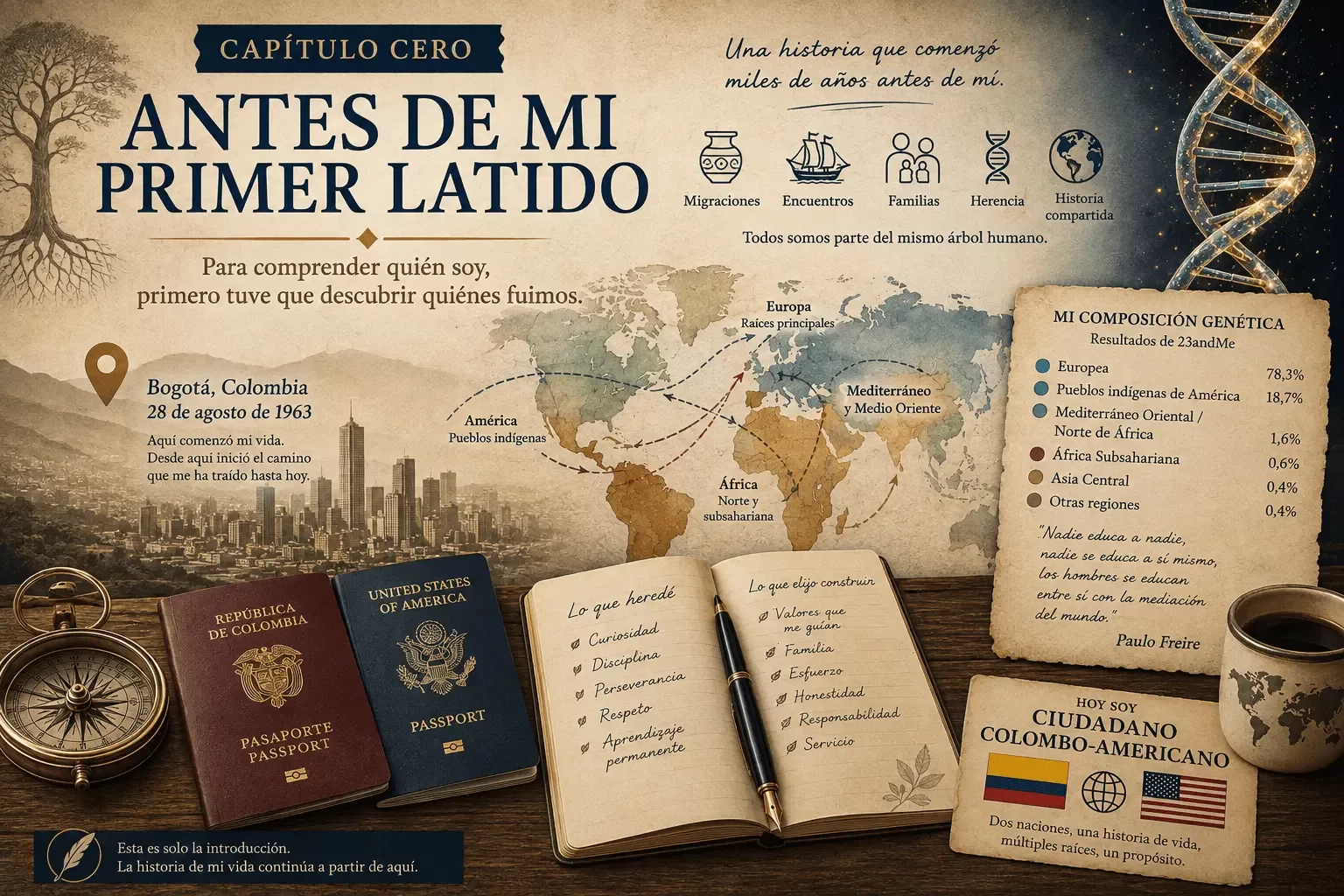
“To understand who I am, I first had to discover who we were.”
I was born in Bogotá, Colombia, on August 28, 1963. My parents were Fabiola Cobo Arizabaleta and Roberto Sarria Ruiz.
For many years, I thought my story began on that August day, when I took my first breath.
Later, I understood that I was wrong.
My story did not begin with me. It did not begin with my parents either.
It did not even begin with my grandparents, whose memories can still live in the minds of those who knew them.
My story had begun thousands of years before Colombia existed; before anyone pronounced the surnames Sarria or Cobo; before the cities, roads, and maps we now use to divide the world existed.
It had begun with countless men and women whose names I will never know.
People who survived wars, epidemics, hunger, and migrations. People who crossed territories and oceans, created families, and continued living without ever imagining that a small part of them would keep traveling from generation to generation until eventually reaching me.
Today we know that part of that history travels inside something extraordinarily small: our DNA.
When curiosity meets science
For decades, I have been curious about my family roots.
I wanted to know where the Sarrias, the Cobos, and all those people I never met really came from, even though their lives somehow made my own existence possible.
Genealogy answered some questions.
Genetics opened a door to a much older past.
I decided to have my DNA analyzed through 23andMe, an American company dedicated to personal genetic analysis. Using a saliva sample, this type of study can estimate ancestry components and explore lineages and migrations related to our ancestors.
The results do not replace family history or the documents that a family may preserve. In my case, I understood them differently: as a scientific tool that could complement what I already knew and allow me to look at my own history from another perspective.
And what I found made me even more curious.
A story written over thousands of years
I discovered that almost four-fifths of my genetic heritage comes from Europe, mainly from the Iberian Peninsula, with a significant presence connected to Andalusia, Asturias, and Castile.
The analysis of my paternal line points to an ancient Eurasian root that spread throughout Europe over thousands of years, while my maternal line reaches back toward the Middle East and later moved toward Central Asia and the European continent.
Centuries later, part of that ancestral legacy would cross the Atlantic with migrations toward the New World, eventually meeting in Colombia with my Indigenous American roots.
But the story does not end there.
My genetic composition also contains traces associated with ancient Italian, Portuguese, Galician, Basque, Scottish, and Ashkenazi Jewish populations.
And almost one-fifth of my DNA corresponds to Indigenous peoples of the Americas.
That part of the results had a special meaning for me.
My genetics point particularly toward ancient inhabitants of the Cundiboyacense highlands, precisely the region where, many centuries later, I was born.
When I think about it, I find something beautiful in that coincidence:
it is almost as if a small part of history returned to the same place where it had begun.
America was also inside me
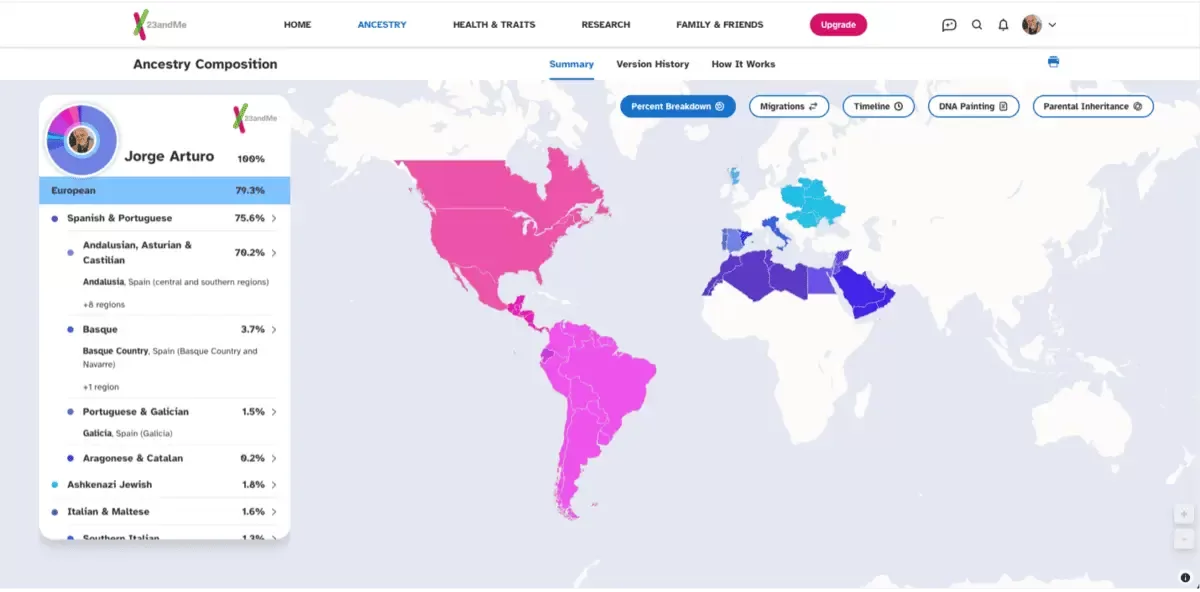
The results also show traces connected with ancient Mesoamerican peoples, North American communities, and Andean and Amazonian populations.
That reminded me of something we can easily forget when looking at today's political maps: America had been connected for a very long time before the borders that now separate our countries existed.
But there was another discovery that especially captured my imagination.
I found small traces connected with the Eastern Mediterranean and North Africa.
They are small percentages, some almost imperceptible, associated with Levantine, Arabian Peninsula, Egyptian, and North African populations.
For me, their importance is not in the size of the percentage.
It is in what they represent.
For thousands of years, merchants, pilgrims, conquerors, religious travelers, and entire families moved from one territory to another. They crossed seas, changed cities, created new families, and left descendants behind.
None of them could have imagined that thousands of years later, a tiny part of that history would appear in the DNA of someone born in the Colombian Andes, 2,640 meters above sea level.
One enormous human family tree
One of the possibilities that caught my attention the most was being able to compare segments of my DNA with genetic information obtained from archaeological remains of people who lived hundreds and even thousands of years ago.
Among those results are genetic matches with individuals from very different periods and places: Iron Age Poland, pre-Columbian inhabitants of the Caribbean, medieval Spanish populations, ancient people connected with the Maya civilization, and even individuals who lived during the time of the Roman Empire.
This requires an important clarification.
It does not mean that I am a direct descendant of those particular people.
It means something that, to me, is perhaps even more fascinating.
We belong to the same enormous human family tree.
Some branches of our families were connected at some remote moment in history.
When we go far enough back in time, many of the divisions that seem so important to us today begin to look much smaller.
And all of us are, in one way or another, distant relatives.
So, where am I from?
Looking at those results made me understand something I had never thought about in this way when I was in school.
I am Colombian.
Deeply Colombian.
But for me to exist as a Colombian, thousands of years of human movement had to happen first.
There are European and American traces in me.
Mediterranean and Andean.
I carry a part of the Indigenous peoples who walked these mountains long before the Spanish arrived.
I also carry traces of people who, at different moments in history, lived in places such as Andalusia, Galicia, Italy, the Eastern Mediterranean, and North Africa.
Every generation added a small piece.
Until, eventually, the person I am today appeared.
But DNA cannot tell my whole story
Here I found perhaps the most important reflection from this journey into my origins.
Genetics can help me understand where some of my genes came from.
It can offer clues about migrations that happened hundreds or thousands of years ago.
It can connect me with regions of the world that I would never have imagined were related to my story.
But there are things that no genetic test can explain.
DNA cannot tell me why I ended up dedicating a large part of my life to creating software.
It cannot explain why I decided to study again as an adult.
It cannot explain why I want to teach, write, research, or share with others some of what I have learned.
It cannot explain my decisions.
My mistakes.
My dreams.
My affections.
The people I have loved.
The times I had to start again.
All of that belongs to another kind of inheritance.
One that is not written only in our genes, but one that we build as we live.
And that is precisely the story I want to tell.
Because after traveling symbolically thousands of years into the past, trying to discover where I come from, I have to return to the point where my own memory begins.
Bogotá. August 28, 1963.
That day, a child was born who could not imagine that he carried thousands of years of human history inside him.
He could not imagine the places he would go, the people he would meet, the mistakes he would make, the things he would learn, or how many times he would have to start again.
But that part of the story no longer belongs to my ancestors.
That story begins with me.
And that is the story I will continue telling in the next chapter.
Transparency regarding the use of AI: I use artificial intelligence as a tool to support editorial, creative, and research work. The ideas, experiences, opinions, and decisions regarding published content are my own and my responsibility.
[See my policy on authority and use of artificial intelligence →]
Comments
Email-verified comments will be added in Phase 2.