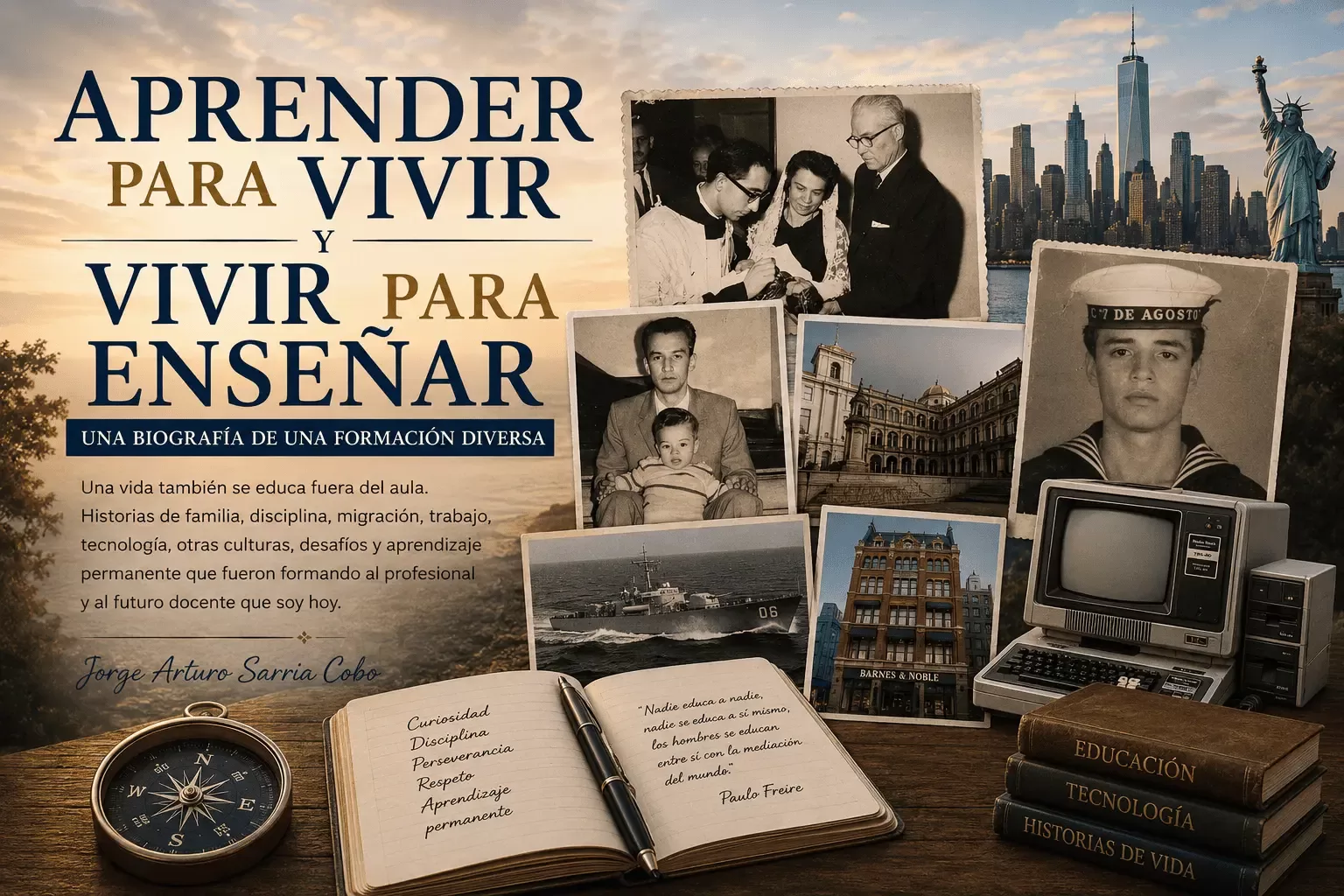
Some stories are written to tell what a person has done. This one was born for a different reason: to understand how I became the person I am and, especially, how I learned what I now hope to teach.
Learning to Live and Living to Teach: A Biography of a Diverse Education began as an autobiographical exercise during my pedagogical studies. But as I continued writing, I realized that I was doing something different from simply putting together dates, places, studies, and jobs.
I was trying to reconstruct my own education.
And I discovered that an important part of that education had happened outside a classroom.
I learned from my family and my first teachers. I learned from religious education and from the Jesuits. I learned from military discipline and from technology. I learned by programming computers, working, making mistakes, and starting again. I learned as an immigrant, living and working with people from different countries, cultures, and ways of thinking. I also learned from difficult moments, illness, loss, and those circumstances that force us to stop and ask ourselves what we want to do with the time we still have ahead of us.
For that reason, this is not intended to be only the biography of a software engineer.
Technology has an important place in my story because it has been part of most of my life, but these pages are mainly about something else: the education of a human being.
When I wrote the original text, I chose as its epigraph these words by Paulo Freire:
“No one educates anyone else, nor do we educate ourselves; we educate one another in communion, in the context of living in this world.”
Over time, I understood how closely that idea represents what I am trying to tell.
My education did not come only from teachers or educational institutions. It also came from the people I met, the countries where I lived, the cultures I came to know, the jobs I had, the difficulties I faced, and the experiences that life placed in front of me.
Each one of them was, in some way, an educational experience.
Every person could teach me something.
Every place changed, at least a little, the way I looked at the world.
Every difficulty forced me to learn something that I probably would not have learned in another way.
And every stage helped build the child, the student, the sailor, the immigrant, the programmer, the professional, and the man who, after several decades dedicated mainly to technology, decided to prepare himself to enter a classroom as a teacher.
Perhaps that is why the title finally became so meaningful to me:
Learning to Live and Living to Teach.
For much of my life, I learned because I needed to. Technology changed, countries changed, jobs changed, and circumstances changed too. Learning was a way to adapt, move forward and, many times, start again.
Now I want part of what I have learned to be useful to others.
Not because I believe my life is an example that others should follow.
I have made mistakes. I have made good decisions and bad ones. I have experienced successes and failures. I have changed my mind many times, and I hope I will continue doing so whenever I find better reasons to think differently.
That is precisely where I find the value of telling this story.
A life does not have to be perfect to teach us something.
From an academic biography to a blog series
The document that gave origin to these texts was initially written as an autobiographical account connected with my pedagogical education. Today, I have decided to give it a second life by publishing it on this blog.
Not as a book placed in front of the reader all at once, but as a series of stories.
From Chapter Zero, “Before My First Heartbeat,” to Chapter 9, “The Final Climb Up Everest,” I will publish each chapter as an independent blog post, preserving the meaning of the original work while adapting it to a more natural reading experience for this medium.
Some stories take place in Colombia.
Others, far away from it.
Some are clearly about education.
Others may seem to be about computers, ships, immigration, work, travel, or illness.
But they all have something in common:
in every one of them, I was learning.
Many times without even realizing it.
Why share it now
I am reaching a stage of my life when the most important question is no longer only how much more I can learn.
The question is:
What can I do with everything I have learned?
My answer is becoming increasingly connected with education.
After decades working with software development and technology, I have decided to prepare myself as a teacher as well. Not to leave behind what I have been, but to give it continuity.
Because today I believe that teaching is not simply about transferring knowledge.
Knowledge changes.
Technology changes.
The tools we consider essential today will one day be replaced by others.
But some lessons remain: curiosity, discipline, respect for others, the ability to think, to adapt, to stand up again after failure, and to continue learning.
That is what I truly hope to share.
The epilogue of my biography expresses this idea better than any professional description I could write about myself:
This was never really a story about a programmer or about computers.
It is a story about curiosity.
About discipline.
About the ability to start again.
About understanding that every human being has something to teach us.
And about my conviction that education remains one of the most powerful tools we have to transform a life.
If my own story demonstrates anything, perhaps it is something very simple:
the world can profoundly change a person when that person never stops learning.
That is why I have decided to share these pages.
Not simply to tell you who I was.
But to try to understand, together with you, everything that helped shape me into the person I am today and the person I still hope to become.
Welcome to Learning to Live and Living to Teach: A Biography of a Diverse Education.
This is my story.
But above all, it is the story of my education.
Jorge Arturo Sarria Cobo
Transparency regarding the use of AI: I use artificial intelligence as a tool to support editorial, creative, and research work. The ideas, experiences, opinions, and decisions regarding published content are my own and my responsibility.
[See my policy on authority and use of artificial intelligence →]
Comments
Email-verified comments will be added in Phase 2.